Thursday, 7 July 2011

Davis Cup Ineptness

What do Serbia, Switzerland, Great Britain and Spain have in common? They all have a player who is in the Top 4 of the World. (Three of them have produced players who don't collapse after missing a simple forehand at one set up) In terms of the Davis Cup rankings, Spain are 1st and Serbia 2nd. Switzerland are a respectable 18th. Great Britain are 43rd and currently languishing in Europe/Africa Group 2. The Davis Cup format is impressively complex, but that means that we are currently very far away from the World Group.

Ahead of Great Britain lie countries with a fairly unimpressive pedigree. New Zealand check in at number 40, with household names Artem Sitak and Michael Venus leading them to a narrow defeat to Uzbekistan last time out. Peruvians Ivan Miranda and Mauricio Echazu are both outside the top 400 in the world, but a 5-0 win over Netherland Antilles means they sit at 41. We are at least ahead of the Dominican Republic and tennis powerhouse Monaco. Lets look at how we got into this mess:

AUSTRIA DEBACLE


In September 2008, Great Britain took on Austria for a place in the world group. Austria's top player was Jurgen Melzer but beyond that they lacked strength in depth. However, in this post-Henman and Rusedksi world, GB were in an even worse position. Andy Murray did what was expected, notching up two victories. Alex Bogdanovic looked half decent for spells but was not good enough to beat either Melzer or Peya (who was higher ranked than him). The match hinged on the doubles, and despite a team of Jamie Murray and Ross Hutchins looking good on paper, Melzer gave an early indication of what success lay ahead for him on the doubles circuit by teaming up with Julien Knowles to hammer them in straight sets. GB were down to Europe/Africa Group 1.

Particularly Inept: As a result of failing to beat two players higher ranked than him, Alex Bogdanovic was dropped from the Davis Cup squad. The logic behind this is enough to make your head explode. It is not Bogdanovics fault he is British number 2, rather than number 15 or so had he been Alexo Bogdanovico from Spain. However, Captain John Lloyd was confident that his plan of sending out an even worse player would pay off.


UKRAINE DEBACLE


GB could have secured an instant return to the World Group playoffs as they took on Ukraine at Braehead. At the start of the week, Andy Murray pulled out as he realised the effort of winning two matches only to lose overall was not for him. A team including Josh Goodall and Chris Eaton was swept aside by a team that, while containing no superstars, did at least include two players in the top 100. That was enough to secure a quick 3-0 lead, although Chris Eaton did win one of the dead rubbers, beating Marchenko, who controversially chose to play while sitting on a chair and reading a book he was desperate to get finished.

Particularly Inept: In a staggering dereliction of duties, John Lloyd decided that rather than do the one job he was required to do in role of captain, that of picking the team, he would instead host a Davis Cup play off. Six players were forced to play off at Roehampton for the joys of being criticised for losing to better players in the match itself. James Ward and Chris Eaton contested what was then the worlds longest tennis match, while John Lloyd presumably lit Cigars with £50 notes at the side of the court.


POLAND DEBACLE


Poland had little in the way of singles talent, but none of that mattered as they had a top ten doubles pairing. Presuming both their players could beat GB number two (Dan Evans this time), then they would win 3-2. Despite Murray being injured, he comfortably beat the Polish players, while the doubles went to Poland. However, Dan Evans never came close against two players ranked outside the top 150, and Great Britain lost again. Andy Murray was out of action for a few weeks after aggravating his injury, and decided it really wasn't worth the effort.

Particularly Inept: One area where Britain is reasonable is doubles. Ross Hutchins, Colin Fleming and Jamie Murray were all either top 100 or heading there. Jamie Murray was left out altogether, and Fleming was picked and didn't play. Instead Andy Murray was forced to play doubles despite an injured wrist. The others may also have lost, but as doubles specialists had about as much chance as Andy. John Lloyd risked the singles career of our only competent player when we had plenty of doubles specialists available.


LITHUANIA DEBACLE


At this stage, we had dropped so low we eventually had to reach a stage where 300 ranked odd players might actually get a few victories. Welcome to Group 2 of Europe/Africa, reserved almost entirely for countries where tennis is not actually a sport, and the chances are if you can hold a racquet you are in the team. Lithuania had a player, Richard Berankis was 198 odd in the world, Laurynas Grigelis at about 518. Terrible, terrible players. Grigelis doesn't even have a Wikipedia page. Obviously Andy Murray wanted to play, but he had agreed to walk the dog that night and didn't want to tell his girlfriend to do it at such short notice.

The doubles team of Fleming and Skupski won, so we just needed Dan Evans to beat a player ranked 200 places below him and without a Wikipedia page. He lost in 5 sets. To a player ranked 200 places below him. From a country who's entire tennis budget was only £90,000.

Particularly Inept: This result was so inept that really the LTA should have been disbanded and everybody involved rounded up and fired, out of a cannon, into the sun. John Lloyd was only fired. The LTA spend five times more on lunches than the Lithuania Tennis Association spend in total.


In a happy ending, Great Britain finally sank so low that they could win a match. They beat Turkey 4-1. Turkey included a player who was actually just a college student and who didn't have a world ranking. Seriously. That is actually the level we reached.

Sunday, 3 July 2011

Thoughts on Wimbledon

So another Wimbledon is over, and 99% of the people who watched the final will now go back to ignoring the sport completely, yet still feel confident to give an opinion the rest of the year based on what they saw over the last two weeks. What have we learned over the last fortnight?

Andy Murray will never win a Slam


There. It has been said. Like an alcoholic coming to terms with his addiction, its a big thing to admit. But once you have, you immediately feel better. Murray is better than 95% of the tour even on an off day, and can beat the top 3 (and Del Potro) on his day. Increasingly though, his day is not in a Slam. Murray cruised through to the semi finals playing some excellent tennis, while taking advantage of a draw that started looking hellish but opened up nicely. He seemed relaxed and many were quietly confident going into the semi with Nadal.

Personally, I think Nadal was struggling with an injury for the rest of the tournament after the Del Potro match. Because he is not a sore loser like David Haye, he was unlikely to prevent a mis-shapen foot at Sue Barker in the final interview, but I think he was not at his best. Murray won the first set 7-5, and looked to be on top in the early stages of the second set. At 30-30 in the 4th game, he missed an easy forehand. He then collapsed entirely. Despite what the BBC claim, Nadal was merely average for the rest of the match, getting the cigars out as Murrays first serve faltered and ground strokes went flying long. He lost 7 straight games at one point.

As time goes on, the weight on Murray at this stage of a tournament will grow. If he is still, at 24, being phased by one poor shot, then he has no chance. Del Potro is about to come back to demolish everybody anyway, so it may be best just to accept Murray won't ever win and stop getting hopes up. We can just accept his role as a tennis Colin Montgomerie.

                                     Andy Murrays Grand Slam trophy cabinet

There is something dull about Djokovic


Novak Djokovic has proved himself as the worlds best tennis player this year, and that was finally recognised with the World Number 1 ranking achieved by reaching the final. He backed that up with a fairly comprehensive demolition of Nadal. There is no doubt that Djokovic is a very entertaining person, as you can see from any of his performances at charity events or from the impressions he was doing in his early days on tour. But there is something quite boring about the way he is dominating the tour.

When Federer was basically unbeatable from 2004-2007, he did so playing some absolutely breathtaking tennis, which meant people forgot James Blake and Ivan Ljubicic were top 5 players and there was no depth. When Nadal was dominating from 2008-2010, it was generally by beating Federer in some absolutely epic finals. Djokovic has also beat Federer in some great matches, but somehow it isn't quite as exciting. At Wimbledon, everybody was there to watch Murray, Nadal and Federer but nobody was bothered about Djokovic. This may change in the future, but it seems there is something about Djokovic that fails to capture the public's imagination.

Finally, a youngster breaks through


Bernard Tomic has been hyped for a while, reaching the second round at the Australian Open as far back as 2009. Much of the early press resolved round what an absolute dick he was, rejecting a knock up with Lleyton Hewitt on the basis he wasn't good enough and walking off court mid match in 2008. His dad also threatened to quit Australia on the basis he wasn't scheduled properly against Cilic in 2010. However, things have been quieter since then and he finally made an impression at Wimbledon, reaching the quarters with some impressive victories.

It seems odd that since 2008ish (when Del Potro stepped up), nobody has really broken through to even the top 10 of the rankings. In fact is not until you reach 24 in the rankings that you find a player who wasn't well established on tour in 2008 (that being Alexander Dolgopolov). Earlier this year, Milos Raonic made a massive impact before fading away slightly, so it is time for somebody to make a step up.

Against Djokovic, Tomic was one set all and a break up. He then Murrayed the match, losing 7 straight games before going out in 4. Tomic clearly has a lot to work on. His serve could be improved, his movement looked average at best and his backhand seemed a weakness. But at only 18, Tomic will certainly be making an impression soon enough. Whether he merely makes top 10 or whether he starts winning slams is down to just how much work he is willing to put in the next few years.

                                           Tomic's bottle at 1-1 and a break up

The BBC TV pundits don't really seem to follow tennis


I wasn't paying that much attention to the build up, but it did strike me that the pundits had absolutely no concept of there being tennis events outside Slams and Davis Cup. Sue Barker mentioned Djokovics great run in the Davis Cup and Australian Open, but ignored his 100% record in Masters Events he has entered this year. There was little reference to the fact Djokovic had already beaten Nadal in four finals this year, so perhaps could be regarded as favourite. In fact watching the BBC it seems that there are no tournaments in the world outside of the four grand slams and Queens.

I assume Sue Barker, John McEnroe, Tim Henman etc do follow tennis all year round. They must be aware that rather than doing nothing between January and the French Open in May, the players actually play a number of tournaments and the top 4 have played against each other on a number of occasion. While they don't have rights to the tournaments or any highlights, it would be nice if they treated the viewer with a bit of respect and discussed some of the other meetings the players had this year. Given the fantastic coverage they provide on 5live and the Live Text for these events, it seems odd at Wimbledon they aren't mentioned.

Juan Martin Del Potro is back


If Juan Martin Del Potro had not slipped and injured his hip against Nadal, he would probably have won their fourth round match. This is on grass, his least favourite surface. Throughout the match he made particularly late line calls, managed to throw Nadal off his game at one stage by complaining and then spent ages arguing with the umpire after the first set. Essentially, he is just as dislikeable as before. However more importantly he looked like he could mix it with the top players in the world again.

This is more bad news for Andy Murray, but for tennis it is generally good to see him back. He is definitely worth a shout for the US Open, and I would love to see him play Djokovic at least once during the American Hard Court season (which, the BBC should note, does not just involve the US Open. In fact, given that Sky show the US Open, the BBC may not acknowledge that either and just assume tennis is now done for the year).


                                The BBC have confirmed this image as a fake

Saturday, 2 July 2011

Liam Broady

As Andy Murray blew a fantastic chance to reach the Wimbledon final by failing to recover from the traumatic event of missing a forehand at one set up, 2-1 and 30-30 before collapsing in a manner not seen since the last time some women played tennis, talk started to turn to somebody who could be the next British failure at Wimbledon.

By failing to win the title from a set and a break up, Liam Broady is already well versed in grabbing failure from the jaws of victory. However his achievements the last week should be applauded and its good to see some genuinely talented youngsters coming through. However before we get too excited about Broady breaking through, along with Oliver Golding and that guy who won a big tournament in Florida but who I can't remember his name and can't be bothered to google but definitely wasn't Golding or Broady, lets look at previous Wimbledon final runners up and how they have done.

2010 
Benjamin Mitchell
Highest Ranking Achieved: 413


                               Despite what the ATP suggests, I think he has a face


At only 19, and having been in the juniors only last year, we can't read too much into Bens (I assume he goes by Ben and not Benjamin (wiki seems to confirm this)) lack of success so far. He had to qualify for the boys singles before his remarkable run to the final, his only other junior grand slam appearance being the Australian Open 2010. He dashed British hopes by defeating Oliver Golding in the semi finals and took out the number 3 and 6 seeds. He lost in straight sets in the final to Marton Fucsovics.

Since joining the big boys, Mitchell has been playing mainly in challengers. He lost the first round of qualifying at the Australian Open, won a futures event in Australia and has slowly improved his ranking by over 200 places since January. It is far too early to say whether or not he will go on to make an impact in the sport, but I predict he won't.

2009
Jordan Cox
Highest Ranking: 449
                           Cox and Mitchell are often mistaken for each other

Despite reaching the final of junior Wimbledon in 2009, Jordan Cox does not have a Wikipedia page, which does not bode well. He had a very unremarkable junior career, never going further than the last 32 before his shock run as a qualifer to the Wimbledon final. He lost against Andrey Kuznetsov having taken the first set.

Since turning pro, Cox has been playing almost exclusively futures events in USA,  slowly raising his ranking to the top 500. This year, Cox came over to the UK for the grass season, losing in the first qualifying round at Nottingham and Queens, and the second qualifying round at Eastbourne. His total prize money was €330, which means he lost a large amount of money coming over here. So far this year he has earned €4,429, meaning he would have been better off working any career at all than playing tennis.

2008
Henri Kontinen
Highest Ranking: 220


                             All Wimbledon junior runners up look the same

Henri Kontinen was Finlands great hope and provided a huge shock in the semi finals when he knocked out world number 1 Bernard Tomic. He also beat 14th seed Chase Buchanan, who has a fantastically American name. In the final he was beaten by Gregor Dimitrov, who is only now starting to make an impact as a pro after a lot of "New Federer" chat.

Kontinen has been playing mostly futures events, winning 5 titles so far on hard court and carpet. He reached 220 in the world and began to move into the Challenger circuit. In the first tournament of 2011 he managed to lost to Chris Eaton and it appears his career has entered a downward spiral as a result. He did not play between early February and June, due to a wrist injury. His return to tennis in June was going well before he had to retire injured again. Still hope for him yet though.

2007 
Uladizimir Ignatik
Highest Ranking: 176 


This man is one of the top 200 best tennis players in the world. The ATP website really should get him a picture.

Uladzimir Ignatik (lets call him Tom to make things easier) reached world number 1 as a junior and won the French Open in 2007. His career was not without controversy, with allegations he changed his date of birth to play overage as a junior, and having to cope with pushy parents. Donald Young was the victor in the Wimbledon final, before going on to live up to exactly none of the hype when he turned pro.

Tom has also failed to live up to expectations as a pro, tending to hack around the future and challenger tournaments, winning a challenger in China this year. He has yet to appear at a Grand Slam. Tom will probably never push on from his current ranking but looks set to make a career from hanging around the world top 200 for a while yet.

2006
Marcin Gawron
Highest Ranking: 275

Marcin was another of those players who made it to junior Wimbledon final without much in the way of pedigree at that level. He never made it higher than 29 in the world, and faced only one unseeded player on the way to the final, where he was beaten by number 1 seed Thiemo De Bakker.

Since turning pro, Marcin has been playing mainly futures events, winning in Poland in May. His career appears to be as uninspiring as you can imagine, just a series of future events in Europe. He has made less than €80,000 since turning pro, and only €7,700 this year. Not a fruitful endeavour.

2005
Robin Haase
Highest Rank: 52

                                              Finally, a player with a picture

This is the first player on the list to have made it into the top 100. As a junior, he reached number 3 in the world and lost to Jeremy Chardy (who has also gone on to make the top 100) in the final. He turned pro soon after and had some early success, notably knocking out Ljubicic in the Australian Open in 2008. By mid 2008 he was just short of the top 50 before suffering a knee injury that put him out of tennis for nearly a year.

Haase has been slowly working his way back up to the top 50 since then. At Wimbledon 2010 he was leading Nadal two sets to one in the second round, having knocked out James Blake in the first round. He also won five challengers throughout 2010. In 2011 Haase reached the third round of the Australian Open and Wimbledon and the second round of the French. Having got his career back on track it remains to be seen if he can push on from here. Comfortably the most successful player on this list.

2004
Miles Kasiri
Highest Ranking: 504


Miles Kasiri was the expected to be the next British hope after he reached the finals at Wimbledon in 2004. It all went wrong straight after. Andy Murray quickly emerged, winning the 2004 US Open juniors, and Kasiri suffered injury problems straight away. Kasiri was also suspended from the LTA for a perceived lack of effort after it was said he didn't want to practice his serve, only his forehand. Things just never really happened for him after that.

Kasiri hasn't played a tour match since 2008 and can be considered retired. Luckily for helping with this, it was pointed out on BBC Live Text that he is now a fitness trainer. Lets hope Liam Broady does better than Miles Kasiri at least.

Thursday, 30 June 2011

Federer's "End of an Era" Matches

Yesterday, Roger Federer lost in the quarter finals to Jo-Wilfred Tsonga in the Wimbledon Quarter Finals. Critics were quick to suggest it was finally all over for Federer and that he might not even return to Wimbledon. As Federer defeats at Grand Slams occur with more regularity, the "end of an era" predictions come out after almost every one. With the latest defeat, people are very quick to overlook the fact that this very month, Federer was competing in a Grand Slam final and came as close as he has in a while to beating Nadal at the French Open. A mere 6 months ago, he beat Nadal on the way to winning his fifth World Tour Finals. Lets look at the previous "End of an Era" matches and how Federer has recovered.


2008 French Open
Nadal d Federer 6-1 6-3 6-0


2008 Wimbledon
Nadal d Federer 6-4 6-4 6-7 6-7 9-7


2009 Australian Open
Nadal d Federer 7-5 3-6 7-6 3-6 6-2


In January 2008, Federer lost his first Grand Slam match to a player who wasn't Nadal in three years. Djokovic blasted him off the court in straight sets, but the general consensus was not that an era had ended, but that Federer was simply due a defeat. As Federer tends to do, he has retrospectively put that defeat down to an illness and/or injury.


After one round at the French Open, the Times was suggesting this was the beginning of the end. However, Federer reached his third consecutive French Open final and was once again facing Nadal in an attempt to complete the career Grand Slam. After destroying Djokovic in the semi finals Nadal was favourite but Federer had plenty of chances in 2007 before ultimately falling in 4 sets. 


What happened was quite extraordinary. Nadal won 6-1 6-3 6-0 in an hour and a half. In a Grand Slam final, Nadal had taken a set off Federer to love. The match wasn't even remotely close. The general impression was that Federer would never win the French Open but that he was still the number 1 player on other surfaces. He went into Wimbledon as favourite to win a 6th consecutive title.


Federer and Nadal both reached the Wimbledon final with minimum of fuss, a semi final line up of Safin and Schutller demonstrating that for all the drama of the final, the actual tournament was of fairly low quality. The final itself does not need to be gone over again, going down in history as it does as the greatest match of all time. As everybody knows (if you didn't before, you will have passed the score while reading this article, but why you were reading a tennis blog if you didn't know is another issue) Nadal edged the match and Federer had gone three grand slams without a victory for the first time since 2002.


The general consensus at the time was that Nadal was now the worlds best player. There were serious questions over whether Federer would win more than the 12 grand slams he had at that time. Having just beaten him on his favourite surface, and with an excellent overall head to head record, Nadal looked set to prevent Federer for years to come. As the BBC put it at the time "...defeat on his favourite surface will lead many to question whether he is still the worlds best player". It felt like the end of an era.


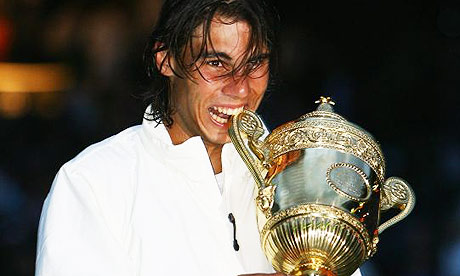
                                        Nadal thinks the trophy is edible. It isn't.


Federer lost early in the Olympics as Nadal confirmed he was the top man by taking gold. However, an inspired Andy Murray made his arrival at the top end of tennis by knocking Nadal out of the US Open at the semi final stage. I think its fair to say had Nadal made it to the final, he would have won. However, Murray froze (a habit he is yet to shake off) in the final and Federer won his 13th Grand Slam. 


However, at the Australian Open in 2009 there was no stopping Nadal, as Murrays incredible run of form stopped suddenly against Verdasco in the 4th round (when many predicted Murray to win the title) and the top two faced off again. For 4 sets the match was an absolute classic, before Federer suffered a fifth set collapse which slightly marred things, and Nadal now held 3 of the 4 Grand Slams. The Guardian noted that Nadal now looked set to be the first to win all 4 Slams. 


                               Federer cries as he remembers what his wife looks like


Reaction: The hold Nadal had over Federer at this stage meant that few thought Roger would regain number 1 or complete the career grand slam. Pete Sampras record of 14 titles was suddenly looking further away than ever. However, Federer went on to beat Nadal on clay at the Madrid Masters and was no doubt the happiest person in the world when Soderling stunned Nadal in the 4th round at Roland Garros. Federer went onto take the title at the French for grand slam 14, then take advantage of an injured Nadal to break Sampras record at Wimbledon. Federer was back at number 1 and achieved everything that looked so unlikely in January.


2009 US Open
Del Potro d Federer 3-6 7-6 6-4 7-6 6-2


Nadal had returned to tour in the second half of 2009 and looked a broken shadow of a man. Federer breezed through the tournament, introducing the world to the "tweener" shot on match points in the semi finals against Djokovic. Del Potro hammered Nadal 6-2 6-2 6-2 but was widely expected to be defeated by the man who knocked him out of the Australian and French Open.


For a set and a bit, Federer was comfortable. Del Potro then resorted to the "being a complete dick" tactic which succeeded in throwing Fed off his game. Forehands started finding their range and Federer was beaten by a player who looked set to dominate the game for years to come. Could this be the end of Federers reign at the top?


                                  Federer wins something else to serve coffee on


Reaction: Once again, a player who had dethroned Federer suffered a serious injury (does Federer have an alibi?) and is only just getting back to his best. Federer went on to face the in form Andy Murray in the Australian Open 2010 final, with many feeling this was going to be Murray s turn to further show that the new breed had taken over. Murray froze again and Federer won Grand Slam 16.


Wimbledon 2010
Berdych d Federer 6-4 3-6 6-1 6-4


A quarter final defeat to Soderling at the French Open saw Federer's epic semi final run come to an end, but somehow the reaction to this was fairly muted. Perhaps with Nadal back, many knew it just prevented the inevitable final defeat. However at Wimbledon Federer was still the King and had not missed a final since 2002. Berdych had done little to suggest he was capable of an upset and it was a massive shock when he prevailed in 4 sets. Sports Illustrated suggested that this was the end of an era. Fox Sports also had this opinion.


Both pieces suggested that we would never see Federer at his peak again. Perhaps an indication of the knee jerk nature of the press, but there is a difference between Federer winning every grand slam he enters that isn't on clay and Federer being unable to compete at all. Essentially the reaction seemed to suggest that as Federer was now vulnerable to defeats in the later stages of slams (lets not forget this was the quarters, not the first round), he wouldn't ever compete again. 


Of course, Federer has retrospectively blamed this particular defeat on a back injury, continuing the run of "matches Federer would have won, in his opinion, had he been fit or played properly" to every single match Federer has ever played.


Reaction: Berdych went on to ruin Wimbledon by defeating Djokovic then deciding not to bother turning up in what I recall as an absolutely terrible final. As for Federer, he has not won a slam since and, in a sense, it is the case that he is no longer guaranteed to at least reach the finals of Grand Slams. 


However, Federer was majestic in London in November at the World Tour Finals, hammering Murray, Djokovic and Nadal on his way to victory. In 2011, he has been the only man (and person obviously, as a woman was hardly going to manage) to beat Djokovic and put in his best performance in the French he has for years against Nadal. Had he won the first set as he should, he would probably have won it.


CONCLUSION


The defeat to Tsonga was shocking mostly as it came from two sets up, and Federer appears to have acknowledged that for once he deserved to lose. Exactly as last year, an end of an era has been declared. Herehere and here, for starters. But we have been here before. It should be accepted that Federer will no longer be reaching finals every time, but this is hardly the end. Federer is currently the third best player in the world and will almost certainly win at least one more major before he retires. He will still be top 4 when Wimbledon 2012 rolls around. As we have seen, it is not possible to just write him off on the basis of one bad result. Federer is on a gradual slide from the top and the latest defeat will not accelerate it.

Tuesday, 28 June 2011

Serena should be happy just to be at Wimbledon

Last week, serena Williams was particularly unhappy at being asked to play on Court 2. She noted that this happened to her and Venus a lot and she did not know why this kept happening. Other women waded into the debate suggesting that it was sex discrimination. Which I assume it absolutely is. Fundamentally nobody goes to Wimbledon to watch womens tennis. An unscientific survey based on conversations in the queue suggested nadal, federer and Murray (but not djokovic oddly) were the main draws. Which moves us to point 1 of why Serena should stop complaining and just be happy to be at Wimbledon.

People go to watch the men

As my official and determinative survey shows, people do not go to Wimbledon to watch the Williams sisters. Not once did I heat anyone remark 'I have queued overnight to watch serena lose the first set to the world number 104 but ultimately prevail'. Not once did somebody say they wished there were more women matches on centre. I did overhear some muttering that the Court 2 line up on Day 7 was disappointing. Why? Because it contained more womens matches than mens.

They get equal pay for far less work

Without wading into the equal prize money debate, it's fair to say it's a disgrace which should be ended immediately. Serena gets to play 3/5 less sets than the men while receiving the same prize money. The games themselves are far shorter too. After her tireless campaigning, Serena has succeeded in getting a considerable amount of money for little work. So she should accept that she might occassionally not be centre stage.

This is not unprecedented

By 2002, Pete Sampras had won 7 Wimbledon titles, and while not the holder had won it in 2000. His second round match was arranged for Court 2. Sampras opted to not throw his toys everywhere and demand respect and just got on with it. In 2007, French Open winner and 06 runner up Nadal (seeded 2) ended up on Court 2. McEnroe, Connors, Agassi, Cash, Stich and Becker all lost on Court 2. All men. All bigger draws than Serena.

It makes no difference

The rules of tennis state a singles court is 79 feet long and 27 feet wide. Always. Court 2 is not shorter or narrower. It is the exact same size as any tennis court Serena has ever played on. Court 2 is also still a show court. She is not being asked to play on a smaller court located 34 miles from Wimbledon and accessible only by boat.

It now doesn't matter

Serena played on Court 2 and won. She played on Court 1 and lost. When news of her defeat reached centre, there was a large cheer. So maybe she should just shut up.

Tuesday, 21 June 2011

Thoughts on Wimbledon Day Two

James Ward Watch


After a first round defeat at Eastbourne saw him almost drop back out of the top 200, Englands number 1 was outclassed at Wimbledon by Michael Llodra, losing in straight sets. However, the 10 points gained mean he could shoot up to somewhere around the top 180 next week. As we all agree, a staggering achievement for a country of Englands size and tennis heritage. And hey, Ward just earned £11,500 he would not have received had he been born anywhere else in the world.

Mahut v Isner isn't all that exciting


                                            The Wimbledon crowd today


Everybody got all excited when they heard Isner and Mahut had been drawn together again. As if another 70-68 set was absolutely guaranteed to happen. It quickly became clear that actually the match between the world number 47 and 94 wasn't actually all that exciting. Sure we tolerated it as they set astonishing endurance records, but at 4-4 in the first set second time around it was already fairly dull for all involved. To be fair, a similar match up equivalent would be Granollers v Kubot or Stakhovsky v Kendrick. Nobody wants to watch those matches, unless the only other option is a women's match and therefore we shouldn't expect too much of Mahisner either. The decision to hide them away on Court 3 wasn't all that silly.


One way to guarantee British success


The organisers at Queens started this cunning idea of having Brits play each other in the first round, and were rewarded when James Ward beat one of the inept Dans that clog up the 200-300s in the world (Cox I think, but I am not convinced him and Dan Evans aren't just the same person), thus having GB in the astonishing position of having two men in the second round of an ATP event.

The women, to be fair, are slightly better and having two reach the second round wouldn't be that surprising. Still, just to be sure, Broady was drawn against Keothovang. Given how British women love to implode from comfortable winning positions, I was quite intrigued to see if this match could be completed before the universe collapsed through the sheer complexity of having both players bottle one match. In the end, Keothovang prevailed and joined Baltacha in the second round. Both did so without too much fuss, bar the typical serving the match out jitters. Both will lose the next round.

Centre Court tickets not all that worthwhile


                                       How easy Federer and Djokovic had it today

Not great value in centre court tickets the last two days. Andy Murray tried to inject some excitement by dropping the first set, but in general the top 4 had an absolute stroll in the first round. Federer dropped 12 points on serve all match, ensuring my prediction that Kukushkin wouldn't win Wimbledon proved correct. Djokovic then dropped 11 points on serve all match as he dispatched with Chardy. Nadal thought about giving Russell the first set, but obviously worked out there was something on TV he had to get back for and fought back for a straightforward victory too.

Plus, you also have to watch some women's matches.


Monday, 20 June 2011

Thoughts on Wimbledon Day One

A statistic to start you off with

Matches won by British players in Grand Slams, excluding top ranked Andy Murray, since June 2008: 0

Matches won by French players in Grand slams, excluding top ranked Gael Monfils, today alone: 2

Matches won by Spanish players in Grand slams, excluding top ranked Rafel Nadal, today alone: 1

Matches won by American players in Grand Slams, excluding top ranked Andy Roddick, today alone: 3

Matches won by Swiss players in Grand Slams, excluding top ranked Roger Federer, today alone: 1

Katie O'Brien should never be given a wildcard again


To be fair to Katie O'Brien, she avoided the classic British failure of winning the first set, leading by a break in the second then losing. And wow, she avoided that hard. Now to be fair, she was playing the world number 47 and a three time Grand Slam semi-finalist. Except those Grand Slam finals were in the mid 1990s and her opponent is 40. We'll leave aside what exactly it says about women's tennis that a 40 year old is in the top 50 (but as a hint, it says its a complete joke), but you would still expect somebody a good 15 years younger to put up a fight.

However, Katie O'Brien contrived to lose the first set 6-0, before at least battling back to only lose the second set 7-5. That was her 8th Wimbledon and she has won only 1 match. Today alone she won £11,500 and has probably banked nearly £80,000 in her career. Its time she was told "never again" and made to qualify herself. Given she used to be in the top 100, she might just about manage too. But almost certainly won't.

What happens if it keeps raining?


The roof at Wimbledon is a fantastic addition, allowing us to avoid repeats of matches from the 1980s in order to watch actual tennis. Of course, Dokic v Schiavone had us all crying out for the large "R" in the corner of our screen again, but that can't be helped. However the roof raises one very interesting question. What happens if it keeps raining?

Lets imagine no play is possible at all on the outside courts for all of Tuesday, Wednesday and Thursday. Wimbledon will essentially be a one court tournament. As a result, would the order of play for those days just be a stream of Mondays cancelled matches getting finished on the only court available? On one hand it is unfair if people pay for centre court tickets and end up watching matches that should be on Court Infinity. But the only other alternative is just to keep playing the Top 4 matches and end up with a situation where Murray has reached Round 4 while some players haven't started Round 1. I wonder if the LTA have a plan in place.

Why do the BBC only really care about Wimbledon?


  Henman is only involved in the finals of grand slams as a pundit, which is the exact opposite of how his career went


The coverage at Wimbledon is fantastic, with streams available to watch from numerous courts meaning you can almost avoid women's matches entirely. A number of top ex-players are in the studio and commentating and there is a highlights on every night. Compare this with the French and Australian Open where the coverage is as follows:

Rounds 1 to 4: Red button coverage, of the main court only, with only commentary and no studio analysis. Often, the commentary is done by that Scottish guy that definitely does football and golf too, and appears to go missing without even being referred to once we reach:

Quarter Finals: If Murray is playing, a studio is found. Sue Barker is wheeled out from where ever it is the BBC keep her. There is a chance that the match will be on BBC 2. However if it looks likely to clash with Country Tracks or Homes under the Hammer then the red button it is. Even at the Australian Open at 4am, the match may not be justified ahead of the rolling 24 news coverage.

Semi Finals: If Murray is playing, this stage is suddenly deemed acceptable to cancel whatever else the BBC was planning on showing. Optimistically, schedulers appear to believe games last about 20 minutes and it isn't soon before Sue Barkers dismembered voice is advising people tuning in for Songs of Praise that it will actually be on BBC2, as if they were just waiting for her order before checking one of the other channels. The other semi final (or both if its not Murray) are kept on the Red Button.

Final: The BBC pretends it cared all along. Tim Henman is in the studio and there is some proper discussion. Viewers are no doubt left perplexed at how there appears to be a major tennis final on their tvs when there hasn't even been a hint of an actual tournament taking place. Many probably believe the French Open is merely a Federer v Nadal playoff, with the other players only invited to Wimbledon.